
Most of the discussion about AI agents focuses on what an agent does on day one. The harder question for a CX leader comes later. What happens after go-live, when call volumes climb, policies change, and nobody has time to listen to every conversation? In our recent webinar, we spent time on that question with the people who built the answer.
Peter McKee from our developer relations team hosted. He was joined by Morgan Norman, CMO; Helen Greul, SVP of Engineering; and Arkadiusz Kwapiszewski, Head of Agent OS. Here are the ideas that stood out. You can watch the full session, including the live product walkthrough, on demand.
Why build an agent that improves other agents
Every dialog agent does real work, whether it's taking a hotel booking or checking the status of an order. To do that work reliably, someone has to configure it, connect it to your systems, and give it the knowledge it needs. Once it's live, someone has to keep reviewing calls, spotting patterns, and testing changes in the hope that booking success or resolution rate moves. Until now, that someone was usually a highly skilled engineer.
Self-improving agents have long been the goal, and the models and tooling are now good enough to make them practical. Every conversation your agent has holds valuable data. At thousands or millions of conversations, finding patterns in that data is exactly the kind of job agents do well.
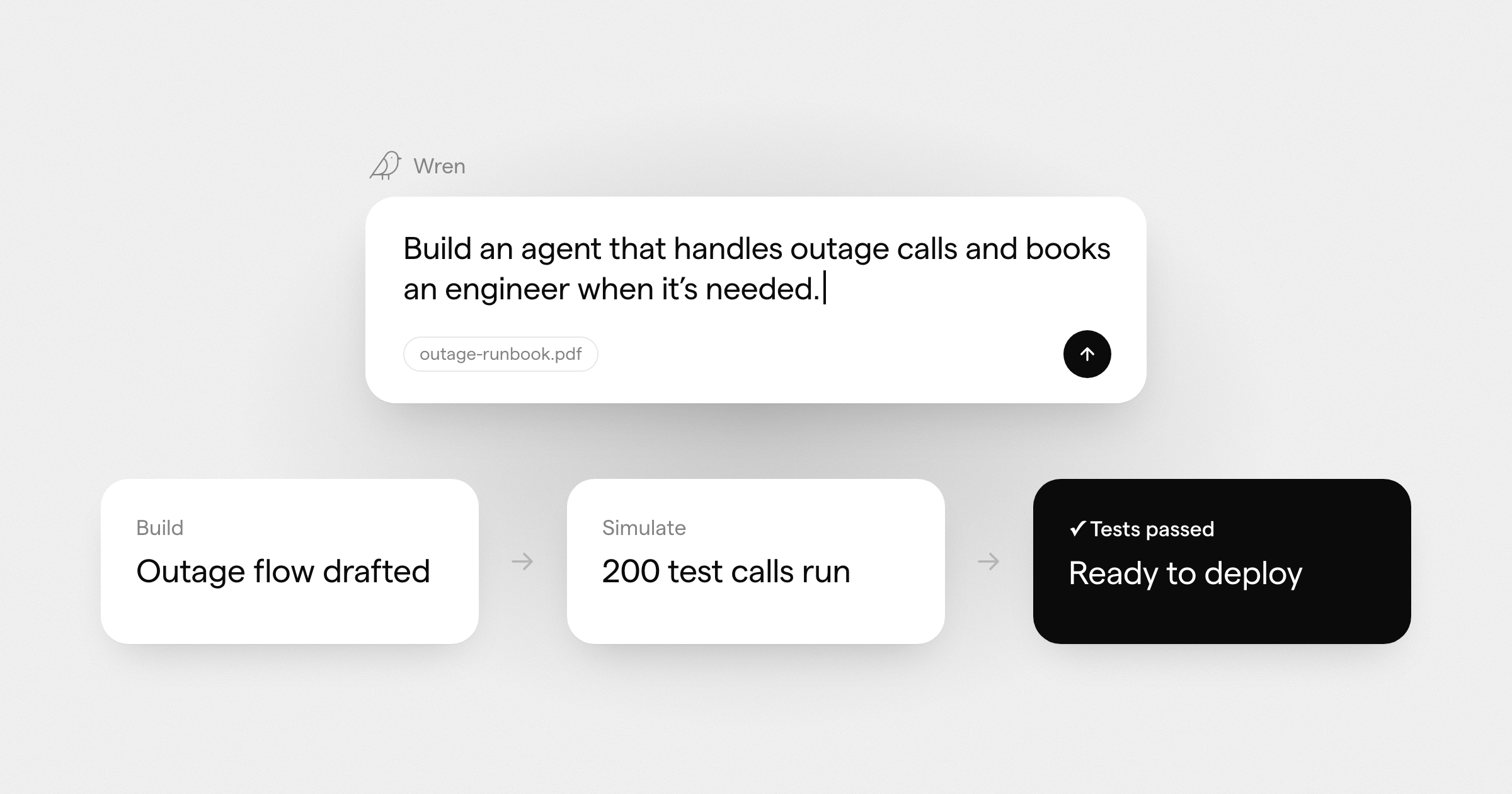
Wren reviews those conversations, feeds what it learns back into your agent, and measures whether each change worked against the KPIs you care about.
The problem CX leaders feel after go-live
Plenty of teams get an agent into production, but it handles a lightweight use case and struggles to scale into the complex, integration-heavy work where the real value sits. Part of the reason is visibility. Ask a CX leader how many calls they reviewed last month to find their next improvement, and the honest answer is usually a small sample. Some say none.
Then there's the question of who does the building. Six months ago, the answer was almost always forward-deployed engineers.
With Wren, someone in support operations who knows the customer journey can find an issue, approve the fix, and ship it. Every enterprise is still working out what that team looks like, and we're learning it together with our customers.
What Wren found first: slow drift
You might expect an agent reviewing production traffic to surface obvious defects. Most of what Wren found in early runs was gradual changes like performance degrading over time. Opening hours change, policies get updated, and an API behaves a little differently than it did last month. Each change is easy to miss unless you read every conversation, which Wren does.
That’s what keeps an agent performing well long after a strong launch. Wren keeps working through the night and over the weekend, so your team can switch off knowing Wren catches the small changes that cause drift and lines them up for review when they’re back.
A new generation of builders
The people engaging most with Wren's recommendations are rarely engineers. They're subject matter experts, like reservations leads, operations managers, and optimization teams who know exactly where the friction sits in their customer journeys.
These teams were always full of ideas and knew what was sitting in their backlog. What they lacked was the time and technical know-how to turn an idea into a working change, and Wren gives them both. That's also why we chose to show Wren working in public.
Your team still makes the call
An agent that makes suggested improvements overnight raises a fair question about trust, and the answer to that is to keep people in the loop. Wren reads, drafts, and tests, and a person who understands the business approves every change before it reaches a customer. Wren never auto-merges. Even when you ask it to deploy or roll back, it spells out what it's about to replace and confirms nothing has changed since you said yes.
Wren is designed never to:
- Guess a business answer it doesn't know
- Try to fix something outside its control, such as a client-side integration
- Claim it ran a test it didn't run
- Ship a change without proof
Wren also inherits the permissions of the person using it, from PII access down to specific knowledge bases and flows. Every decision is auditable, and you can follow Wren's reasoning step by step. That transparency earns trust because you can see what the agent is doing and why.
Inside the daily loop
Wren now sits on the homepage of Dialog Studio. Every day it reviews your calls and sorts what it finds into defects, improvements, and knowledge gaps. Where it can, it drafts and tests a fix, then asks you to approve or dismiss it. Dismissals teach Wren your priorities, approvals are tracked, and a few days later Wren reports back on whether the change moved your numbers.
What it's doing for teams already running it
Brian Jeppesen, Director of Contact Centers at Golden Nugget, opened Dialog Studio, reviewed Wren's recommendations, and pushed them live himself. "Over the previous 24 hours, I had a 33% increase in bookings, a 10% increase in resolution rate, and a 12% increase in conversion. Just by making Wren's recommendations."
Brian's process is the same one shown on our webinar. He has made reviewing Wren part of his daily routine, and he approves around 90% of what it suggests. Not every change produces a jump that size, but small improvements made consistently add up over weeks and months.
Other teams describe the same pattern:
- Alex Grace-Smith at Hawksmoor calls having the analysis wrapped up with coding and deploying "a genuine breakthrough."
- Amy Corcoran at Simplyhealth says work that took hours of manual call review now takes seconds.
- Across production deployments, Wren filed more than 6,000 recommendations in its first 30 days.
What's next
The roadmap includes automatic call monitoring, more notifications and reports delivered to your inbox, more connectors, and more ways to tailor Wren to your business. The biggest near-term opportunity is connecting Wren to the knowledge sources where your policies already live, so it can find answers itself and check them with you.
All of it points to one standard every team should hold its agents to. Your agent should be better tomorrow than it is today, and you should be able to see exactly why.
See what Wren finds in your conversations
Watch the full session on demand to see Wren’s daily loop, the live recommendations, and the rest of the panel’s discussion. When you’re ready to see it working on your own dialog agents, our team will walk you through how Wren reviews your calls and reports back against the KPIs you care about.

What happens if your AI agents get 1% better every day?
- Golden Nugget saw 33% more bookings in 24 hours
- Catch the slow drift that follows every go-live
- Ship fixes your team approves, without an engineering backlog