
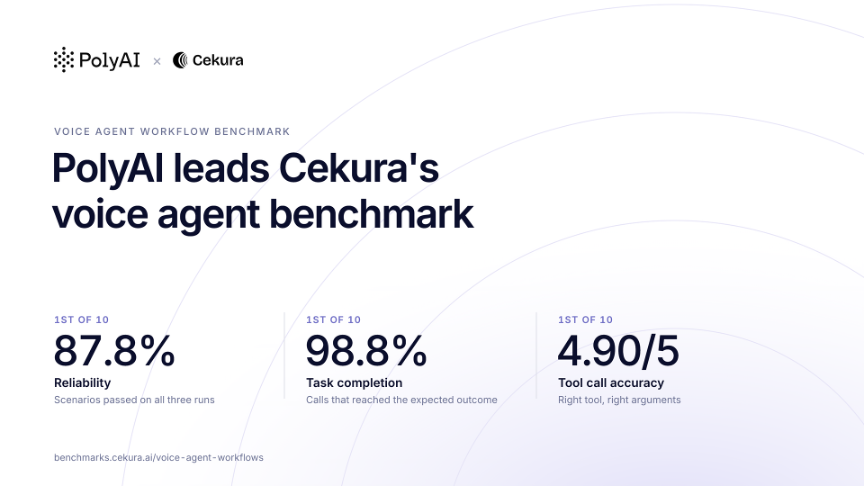
Cekura compared dialog agents built on ten platforms. PolyAI ranked #1 of 10 on reliability, task completion, and tool call accuracy, the three measures of whether a call actually got done.
Cekura, an independent testing platform for voice AI agents, had ten platforms build the same two agents: a clinic appointment line and a Medicare intake line. Next, they compared simulated calls running the same scenarios against every platform and scored the results.
PolyAI ranked first out of all ten on reliability, task completion, and tool-call accuracy.
This matters because getting reliability, task completion, and tool-call accuracy right is essential to building successful dialog agents. Reliability measures whether an agent gets a call right every time, not just once. Task completion shows whether the caller's request was actually completed, not just whether the call sounded fine or stayed connected. And tool-call accuracy shows whether the agent used the right system calls with the right details.
How did PolyAI perform?
Cekura ran 82 scenarios against all ten platforms, three times each, and scored every call. A scenario only counted as a pass if the agent got it right on all three runs, so a single lucky attempt wouldn't skew scoring.
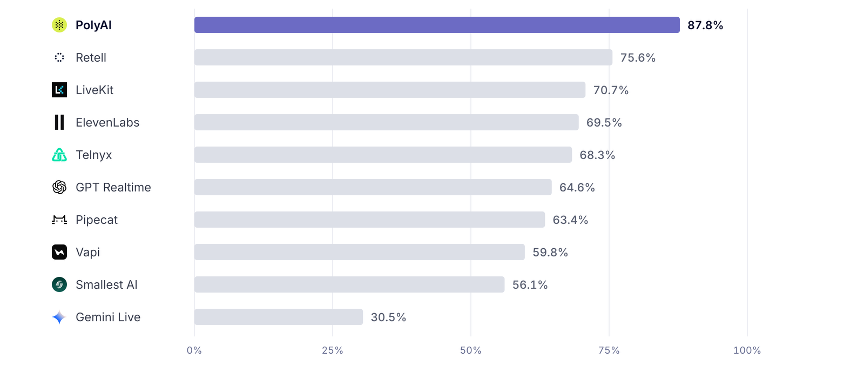
PolyAI finished first of ten on reliability, the benchmark's headline measure, and also scored highest on task completion and tool-call accuracy:
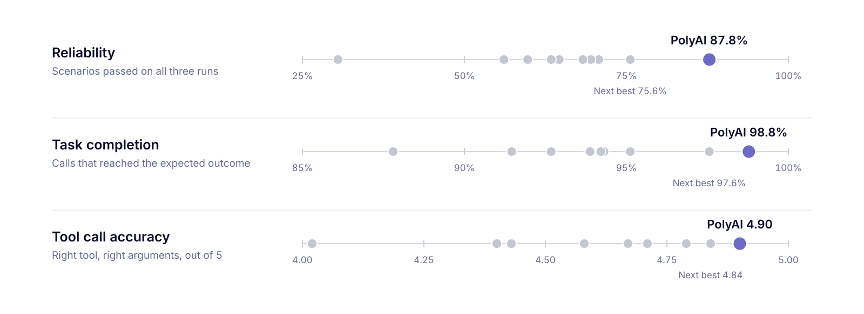
- Reliability (got it right on all three runs): 87.8%
- Task completion: 98.8%
- Tool-call accuracy: 4.90 out of 5
PolyAI also scored 4.99 out of 5 for handling interruptions, second in the field, and 99.2% of its calls were free of connection or platform issues. Its results were also the most consistent of any platform tested: once its agents got a scenario right, they almost always got it right again.
"Callers don't get a best of three, so neither do we. PolyAI was the platform that did the job the same way every time, and that's exactly what our reliability score is built to measure."
Co-founder, Cekura
What's behind the results?
Every platform configured its own agents for the test, choosing its own models and voice tools, so the result reflects what a customer would actually deploy. The benchmark's scenarios, tools, and mock data are open source, and every call recording is public, so the results can be checked directly.
PolyAI's Dialog-RSN-1, the model behind our agents, reasons directly over raw call audio in a single system, handling turn-taking, understanding, and the reply together. That's part of why our results held up call after call, including on the small tool-call errors that often trip up other platforms: a phone number entered incorrectly, a detail missing from the handoff, or a hallucinated answer where a lookup was needed.
What do they mean for teams evaluating a dialog agent?
Reliability, task completion, and tool-call accuracy are three numbers worth asking any dialog agent partner for. They're also hard to fake, since getting them requires the kind of test Cekura ran: the same scenarios and agent definitions for every platform, scored the same way, with nothing edited after the fact.
Four questions worth asking any dialog agent partner:
- What's your completed-task rate on an independently run scenario set, not a self-reported one?
- Does that rate hold up if the same scenario runs more than once, or does it only have to work once?
- Who ran the test, and can I see the actual calls, not just a summary slide?
- How many other platforms were tested the same way, side-by-side?
Build with Poly
Ready to create your own dialog agents? Choose the path that fits how you build.
- No code: start building from a template, describe the agent you want in plain language, and work with our in-platform agent Wren to build and refine it.
- Code: get an API key, install the ADK, and work from your own IDE.
- Enterprise: running at scale? Talk to our team for deployment, security, and support.
Full results for all ten platforms, including every call recording, are published by Cekura on its voice agent workflow leaderboard. Cekura has also published its own write-up of this benchmark, PolyAI leads Cekura's voice agent benchmark, on its own blog.