
For years, the contact center ran inside a set of limitations. Headcount capped how much it could handle. Knowledge sat in systems that didn’t talk to each other. Every improvement waited on a human process, and contact centers primarily reacted to problems after they landed.
As a result, customer conversations were treated as problems to contain instead of opportunities to expand.
AI has changed the equation. In our new State of Customer Conversations research, only 11% of CX leaders report that they still see the contact center primarily as a cost center.
The other 89% see a far more important future for it: the place where trust is protected, revenue is won, and the business gets smarter with every conversation.
Who we talked to (And why it matters)
Most research in this space talks to vendors or analysts. We went straight to the two groups actually involved in these conversations: the business leaders deploying the technology and the customers on the other end of the line.
That’s why we commissioned a survey of 1,045 U.S. consumers ages 18 and up, as well as 533 business leaders at U.S. companies with more than 500 employees.
Our CX leader cohort includes enterprise decision-makers who are in the trenches building teams, managing budgets, and making real calls about where AI fits. The consumer side reflects the general population: people who've been on hold, argued with bots, and had their issues resolved (or not) by whoever or whatever picked up.
The goal of our research was to understand consumers’ attitudes toward customer service, automated experiences, AI agents, dialog AI, and brand loyalty, as well as the attitudes and plans of business leaders across those same topics.
What came back was a massive gap between how business leaders see their service and how their customers actually experience it.
Business leaders & their customers don’t agree on what good looks like
A supermajority (77%) of CX leaders trust their human agents to get the job done without mistakes. Customers see things very differently: 63.5% say agents are only half-listening, and only 21% believe that human agents are always “fully locked in” to their conversations.

The same split shows up in how success gets measured. Ask CX leaders what they optimize for, and most say cost per resolution. On the other hand, customers are focused on speed and accuracy. You can see the full breakdown in the report.
Accordingly, one of the main takeaways from the research is that the business leaders who'll win their customers' trust in 2026 and beyond are those who understand that cost reduction follows from excellent resolution.
Their focus will be on closing the gap between what they assume and what customers actually feel, and that starts with reimagining the role of the contact center.
Three roles contact center leaders are taking on to close the gap
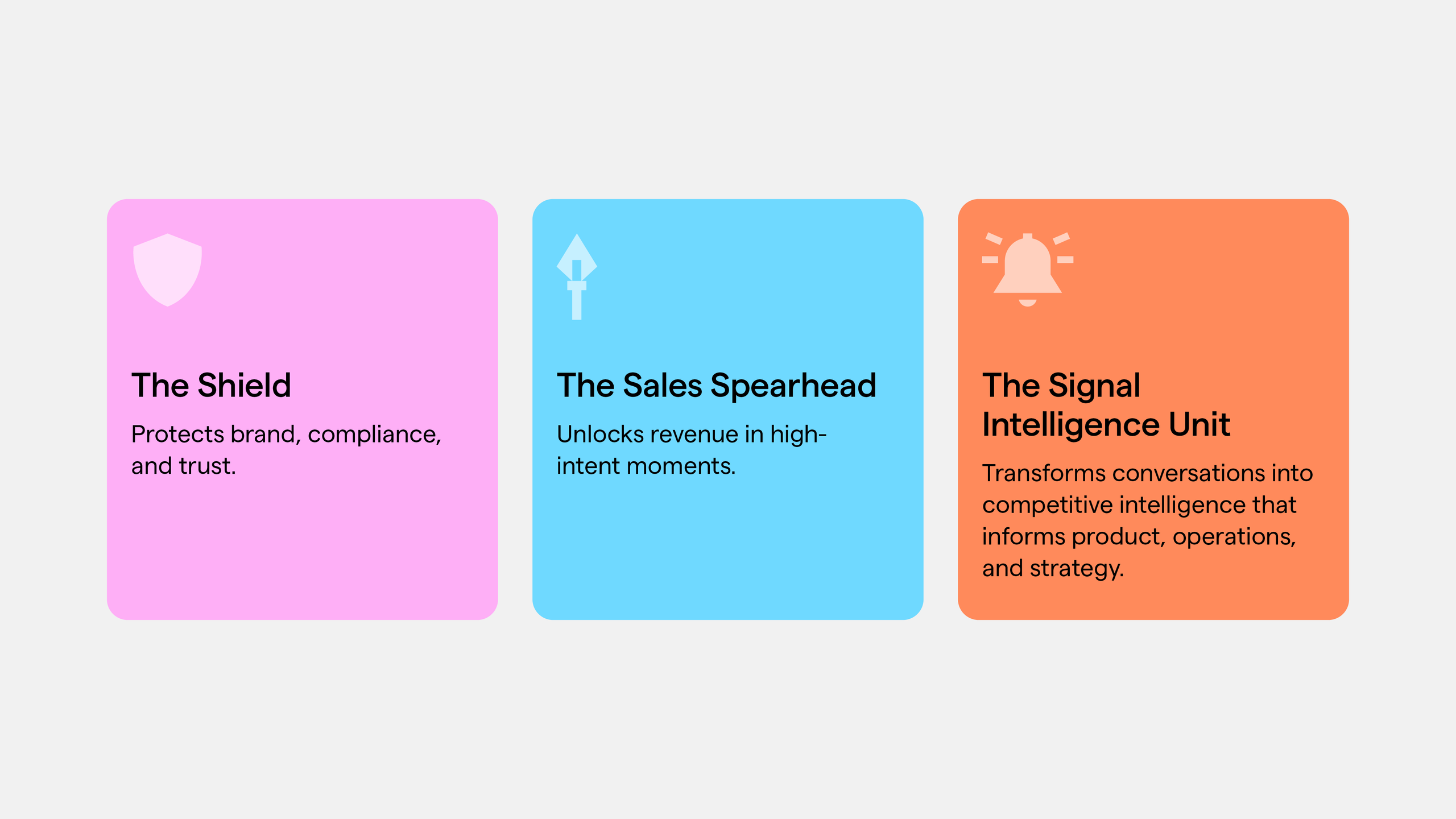
As business leaders move past the cost-center mindset, they're rethinking what the contact center is meant to do. For our research, we asked them if they see the contact center primarily as their organization’s Shield (the place where trust is protected), its Sales Spearhead (where revenue is won), or its Signal Intelligence Unit (how the business gets smarter with every conversation).
Each role shows what AI-powered customer conversations can do for a brand once they're treated as assets, not problems.
The Shield: protecting trust
About a quarter of leaders (26%) describe their contact center’s main job as protecting the brand. It’s the layer that absorbs volatility and holds standards steady, whether a person or an AI picks up. For these leaders, their role is to be The Shield for their organizations.
They’re doing it in a fast-burn environment. According to our research, 23% of customers report they’ll head to social media or a review site right after a bad experience, and 59% will do the same if they feel the service was rude. Nothing about this data suggests that being a shield is easy.
But customers are sending some helpful signals reflected in our report, including how they feel about wait times: 21% would rather clean a toilet than sit on hold. When the alternative is a fast fix, they're not precious about who provides it. In fact, 51% say they'd be delighted to have AI handle their problem quickly, even if it "sounded like a toaster."
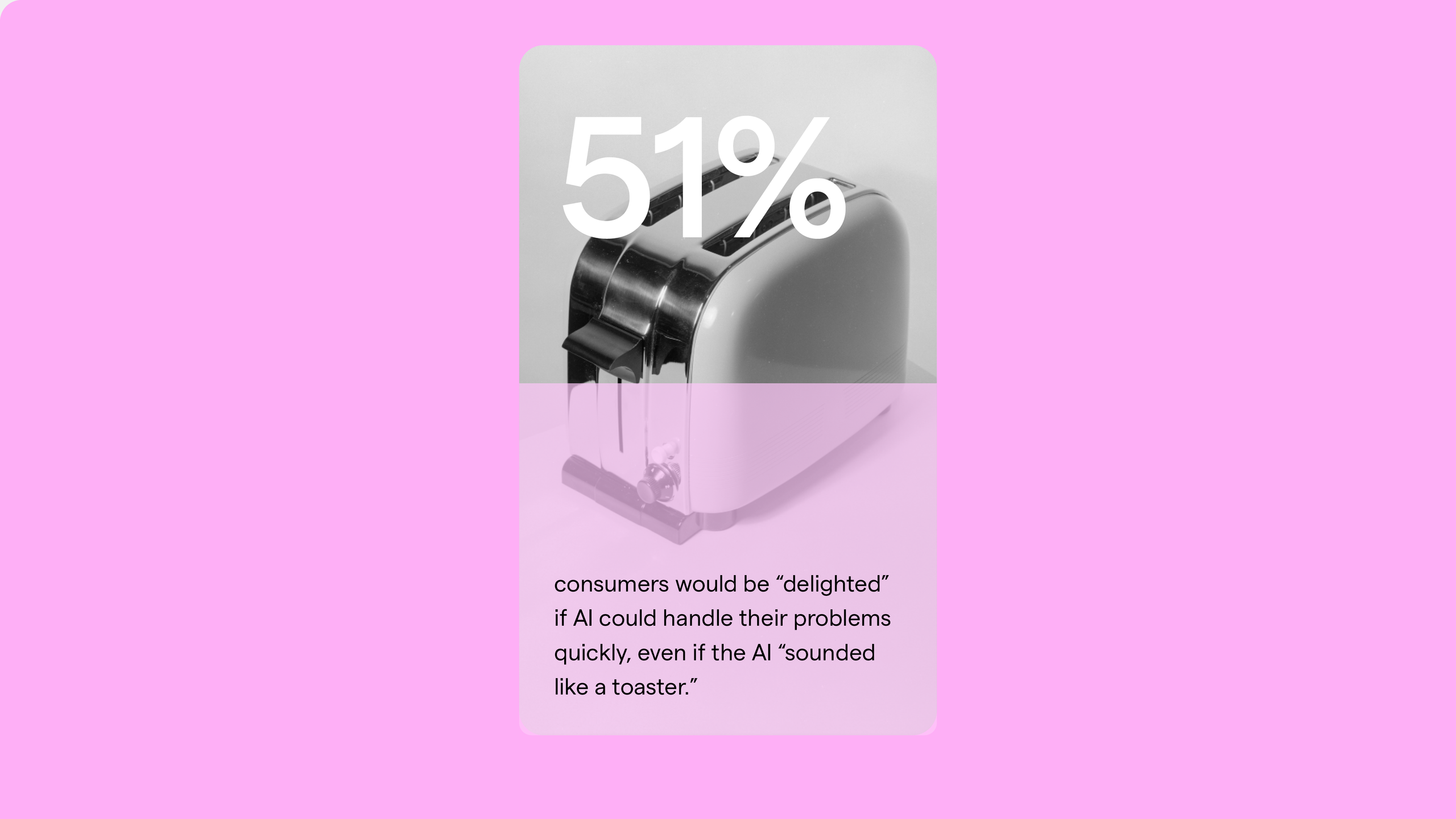
When it comes to being an organization’s shield, the lesson is simple: customers judge the outcome, not who delivered it. A human touch on a slow, clumsy call protects nothing.
The Sales Spearhead: turning conversations into growth
Another quarter of business leaders (exactly 25%) now see their contact center stepping into a revenue-driving role. They know that every inbound contact is a rare moment when the customer's full attention is on the brand, and in today’s world, that attention is hard to earn. Handled well, that moment grows the relationship. Handled badly, it hands it to a competitor. That's the Sales Spearhead: treating each conversation as revenue in play, and more than just a ticket to close.
The stakes are huge. According to our research, a massive 86% of customers say the quality of service resolution affects whether they buy, which puts every contact center interaction directly on the revenue line.
Check out the full report to see which high-intent moments customers are comfortable using AI for, including high-stakes tasks like scheduling medical appointments and transport.
The Signal Intelligence Unit: turning conversations into intelligence
The biggest share of leaders, 38%, now report that they see their contact center primarily as a source of intelligence. If you consider that every conversation carries information about what customers want and where their experience breaks, this approach of treating the contact center as The Signal Intelligence Unit makes a lot of sense. It’s an important change from the past, when most intelligence vanished the moment a ticket closed.
Take repetition as one example. 51% of customers say their single biggest trigger is having to repeat an issue to multiple agents. Treating this stat as a signal, you can map the exact handoffs where your systems and teams break down, and flag the customers most likely to abandon you.
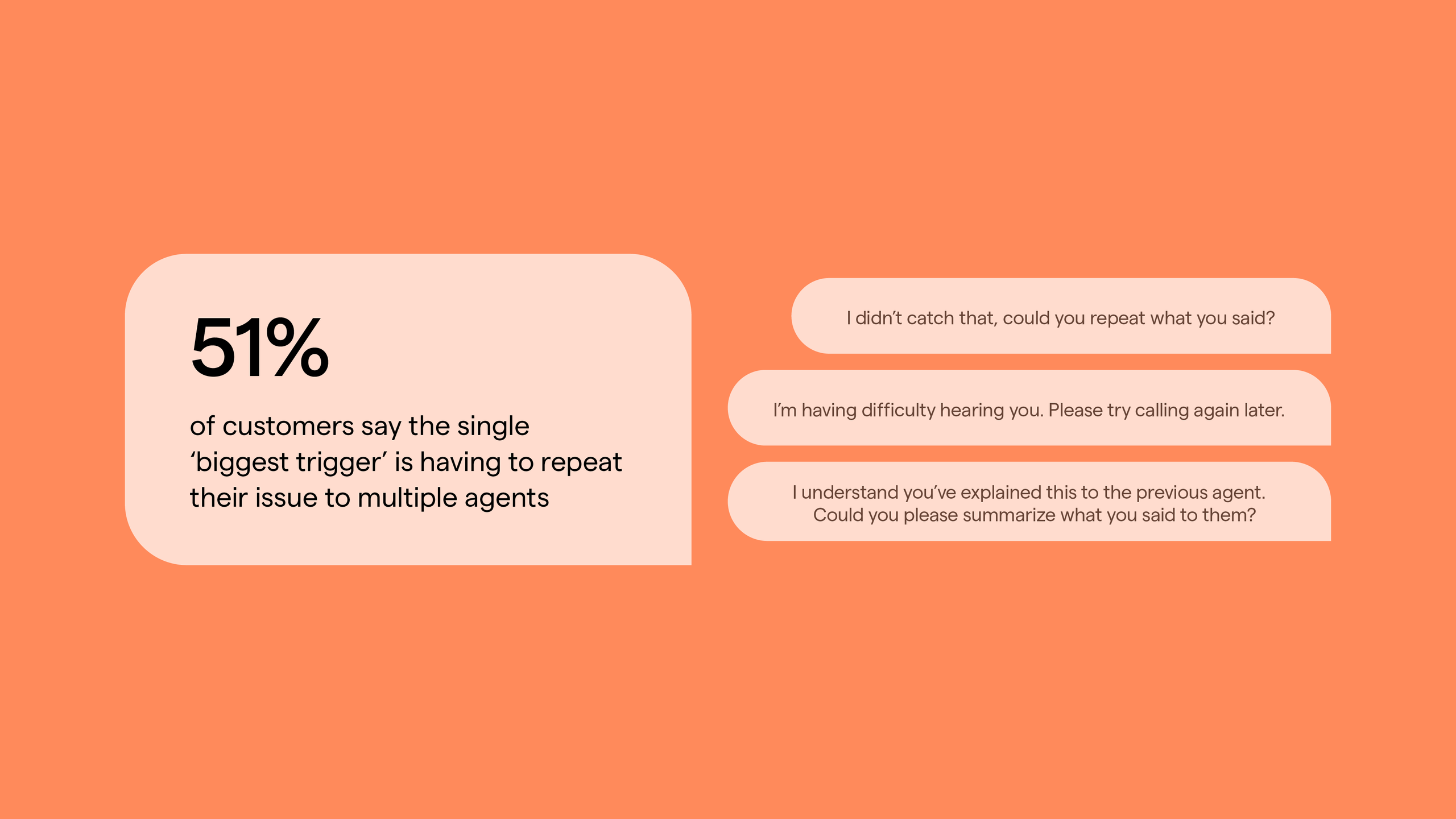
That's the kind of intelligence hiding in every customer conversation. When the contact center runs as a Signal Intelligence Unit, dialog AI can structure that data at scale and start answering questions leaders could never reach before. Download the full report to understand how you can do the same.
Analyzed at scale, these everyday complaints become strategic insight, and that only compounds as agentic AI handles more of the conversation load. Every one of those automated conversations captures the same signals a skilled human would, at a volume no human team could match.
But that intelligence is only as good as the AI capturing it.
Choosing a true AI partner
None of this works with general-purpose AI aimed at a job it was never designed for. That fact is reflected in how leaders rate their AI vendors today: 47% call them “service providers, nothing more,” 19% say they operate only reactively, and 4% say they barely hear from them once the contract is signed. Only 30% see their AI vendor as a “true partner.”
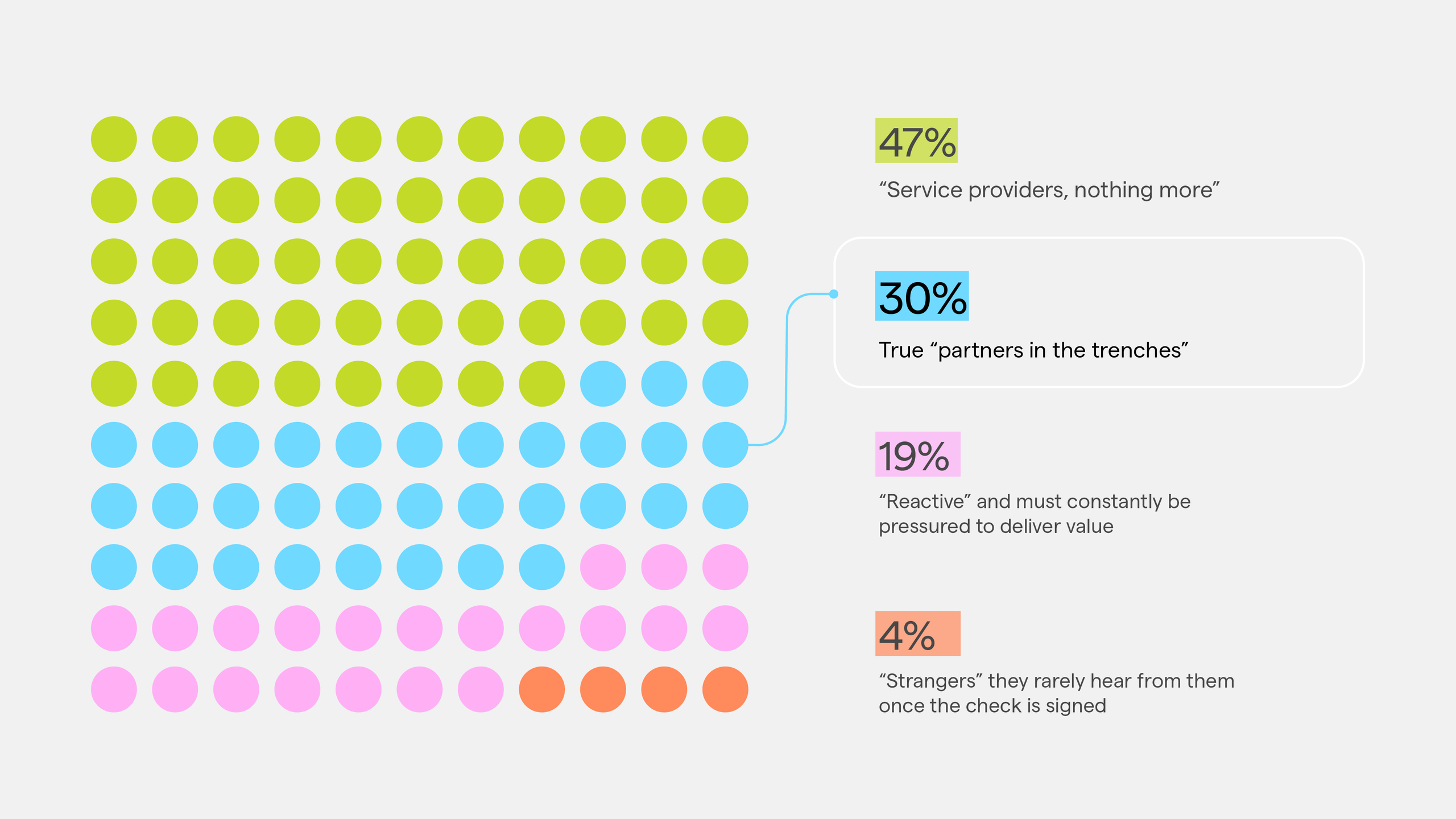
So when it comes to customer conversations, choosing the right vendor is essential. Based on the results of our report, that means finding a partner who can help your organization use the contact center as a vehicle for protecting the brand, increasing revenue, and generating insights — not just cutting costs.
The contact center as command center
In 2026 and beyond, the contact center will become the part of your business where customer relationships are won or lost. Operating as The Shield, it protects trust. Functioning as The Sales Spearhead, it drives growth. And when deployed as The Signal Intelligence Unit, it turns conversations into insights that make the entire business work better. The most effective enterprises use it as all three.
Consumers are more open than ever to AI for customer conversations. They’ve stopped caring whether a person or an AI solves their problems, as long as those problems are solved quickly and correctly. That's the standard your contact center is already being measured against.
Dialog agents are one of the most important tools for making that possible. They listen to what a customer is actually saying, act inside your systems, and resolve the task the way the research shows customers actually want.
Want the full report? Download The State of Customer Conversations 2026 for a closer look at how dialog AI is reinventing the role of the contact center.
CX leaders think their people and systems are delivering. Customers disagree.
The playbook for customer conversations is being rewritten, and the organizations pulling ahead are doing something different.
Get your copy of the State of Customer Conversations Report 2026.